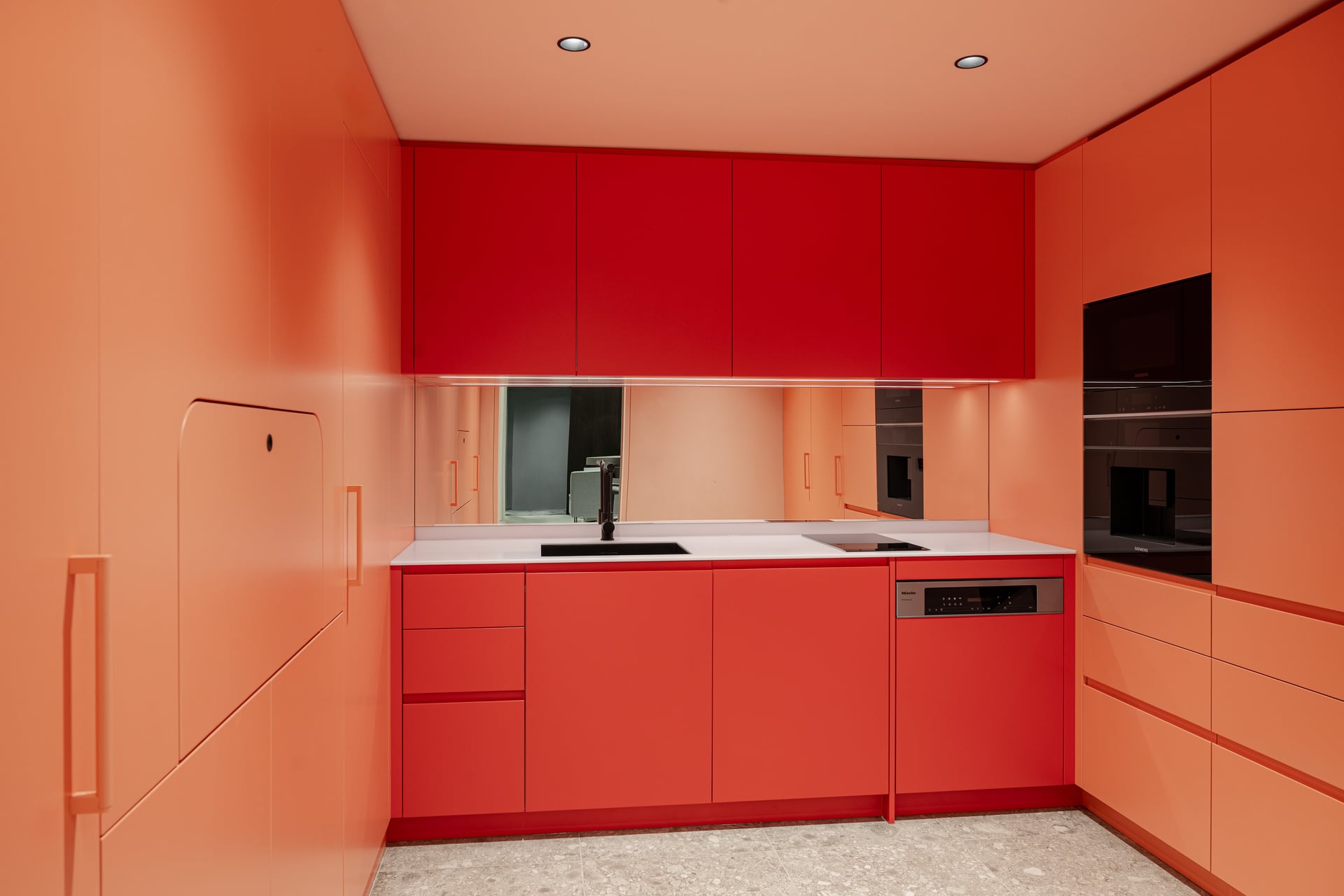
myhive am Wienerberg
Wien |Office
Architect: Fröch Architekten / Photos: Christoph Panzer

Project Description
The workplace environment at myhive am Wienerberg brings together different forms of work, communication, retreat and informal use. The lighting design responds to this diversity by assigning an appropriate lighting character to each type of use.
Pendant luminaires mark table and meeting situations, while linear light accompanies elongated furniture and architectural elements. Additional spotlights and local light sources support smaller lounge and communication areas within the workplace landscape.
Deliberately visible luminaires alternate with light integrated directly into the architecture or furniture. Different mounting heights and forms of light respond to the respective use while also supporting the perception of timber, textiles, glass and coloured surfaces.
The result is not an office environment illuminated uniformly throughout. Communication, meetings, retreat and informal use each receive their own lighting atmosphere while remaining perceptible as parts of one shared and versatile workplace environment.


Project Information
Architecture Type: Contemporary workplace architecture with different work, meeting, communication, lounge and retreat areas.
Lighting Concept & Design Approach: The lighting is based on different forms of work and use. Pendant, linear, accent and local light sources are deployed according to the respective function, giving meetings, communication, retreat and informal use an appropriate lighting character.
Luminaire Integration: A combination of visible pendant and local luminaires with linear lighting systems and directed light sources discreetly integrated into architecture and furniture.
Spatial Effect: A diverse working environment with different lighting atmospheres for focused, communicative and informal uses rather than uniform lighting across all areas.
Questions about lighting design for modern workplaces
- Why do different forms of work require different lighting?
Meetings, focused work, communication and informal use place different demands on lighting. At myhive Wienerberg, different lighting characters are therefore used to respond to the respective function.
- What type of lighting is suitable for informal communication areas in offices?
Local light sources and deliberately visible luminaires can make informal areas more perceptible as distinct places to spend time. This differentiates them from conventionally functional work areas.
- How does lighting differ between meeting and retreat areas?
Meeting areas require light that supports the table and conversational setting, while retreat areas can focus more strongly on a smaller spatial zone. The lighting therefore responds to different forms of use.
- What role do visible luminaires play in modern workplaces?
Visible luminaires can give individual areas their own character and mark specific places of use. At myhive Wienerberg, such lighting objects deliberately alternate with discreetly integrated architectural lighting.
- How can light support different lounge areas within an office landscape?
Different forms of light and luminaire heights can be tailored to the respective situation. This creates areas within a larger workplace landscape that each have their own perception and use.
- Why is uniform lighting not suitable for every modern workplace?
Identical lighting throughout would only partially address the different requirements of contemporary working styles. Use-based planning instead enables different lighting conditions for work, exchange, meetings and retreat.